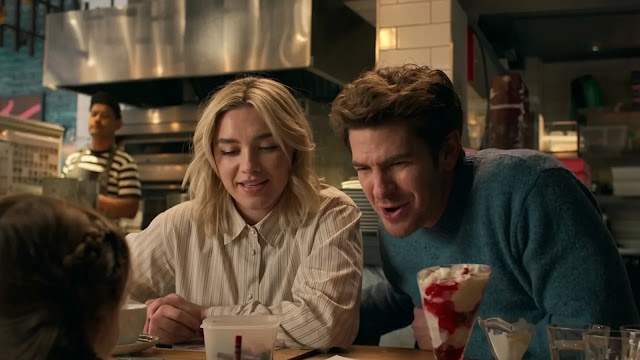
You spend a good part of We Live in Time unsure of when you are. One scene has Almut and Tobias meeting for the first time. The next has them raising a young daughter. Another drops back to a hospital room that resets everything you have watched so far. The film never flags these jumps, and the disorientation is deliberate.
Quick answers first, since people come looking for them. No, it is not based on a true story. And yes, the ending is going to hurt. Almut, the chef played by Florence Pugh, is living with terminal ovarian cancer, and the movie knows it from the first frame even when you do not. It comes from the same wave of streaming grief romances as Reminders of Him, but tells its story in a stranger, smarter shape. The better question is why screenwriter Nick Payne refuses to tell her story in a straight line.
The Playwright Behind the Puzzle
The scrambled structure looks like an A24 mood, the kind of choice a director makes to freshen up a familiar story. It is older than this movie, and it belongs to the writer more than the director. John Crowley, who made Brooklyn, handles it with a light touch, but the time-fracturing is Payne’s design. Nick Payne wrote a play called Constellations back in 2012, a two-hander about a physicist and a beekeeper falling in love. Its idea was radical for a stage romance. The same short scenes played again and again, each pass a little different, as if you were watching every possible version of one couple at once. It ran at London’s Royal Court, moved to the West End, and reached Broadway in 2015 with Jake Gyllenhaal and Ruth Wilson. Payne has spent a career taking love stories apart and laying the pieces down out of sequence.
So the timeline in We Live in Time is not a gimmick borrowed for one film. It is the thing Payne does. What changes is the reason for it. Constellations scrambled time to ask about free will and parallel universes, the physics of what might have been. We Live in Time scrambles it for a plainer and harder reason. Once you know how a love story ends, you stop living it in order. You hold all of it at the same moment. The first kiss, the diagnosis, an ordinary Tuesday morning, they sit side by side in memory, and the movie builds that sensation into its shape. Grief does not wait at the end of this relationship. It has been in the room the entire time, one cut away, and the structure is honest about that in a way a straight chronology could not be.
What the Order Does to You
Watched in sequence, this would be a straight weepie. Couple meets, couple is happy, one of them gets sick, one of them dies. Watched out of sequence, it becomes something you assemble yourself, and the assembling keeps you from bracing for the worst. A small scene of Almut showing her daughter how to crack an egg her own way plays like nothing until you have already seen a later morning with only the two of them at the counter. Joy and grief stop taking turns. They share the frame.
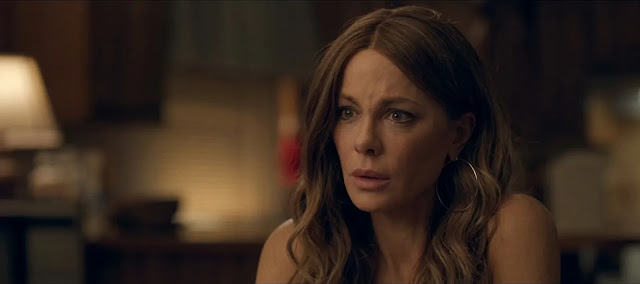
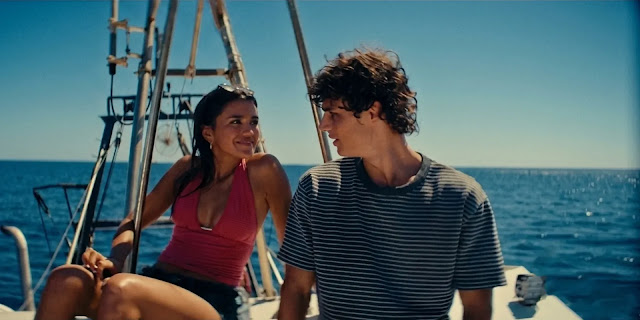
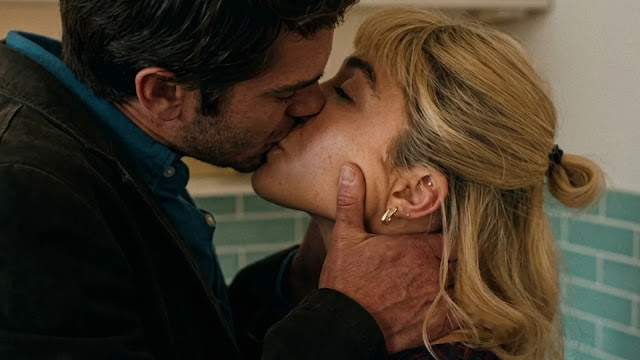
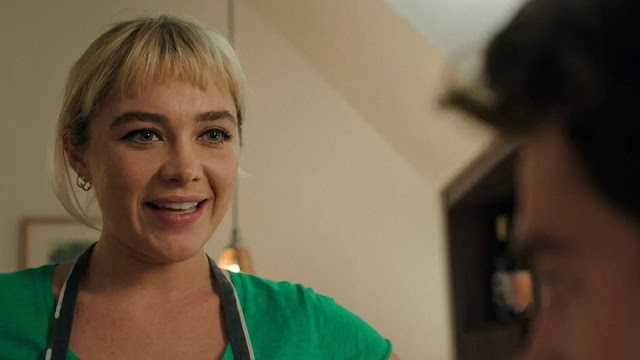
Florence Pugh and Andrew Garfield sell it without pushing. Their first meeting tells you the movie’s instincts are good. She hits him with her car while he is walking out to buy a pen to sign his divorce papers, and the scene is funny before it is anything else. Pugh plays Almut as someone who cannot stand being handled with care, which is why her big late choice, entering an international cooking competition in the middle of treatment instead of resting, plays as stubbornness with a point. Garfield takes the harder and less showy job, loving a person who will not slow down for him. Near the end, Almut leaves that competition mid-service, collects Tobias and their daughter, and goes ice skating, moving like the figure skater she once was. The film would rather show you that than a hospital bed.
I think the order is not a trick played on the audience, it is a mercy. A straight version would march you to the end and dare you not to cry. This version scatters the ending across the film so no single scene has to carry it, and somehow that makes it hit harder. We Live in Time sits with the smaller films that care more about tenderness than plot, closer in feel to the goodbye in Heartstopper Forever than to a standard illness drama. The one stretch that strains is a competition subplot that leans on montage while the rest of the film trusts small rooms.
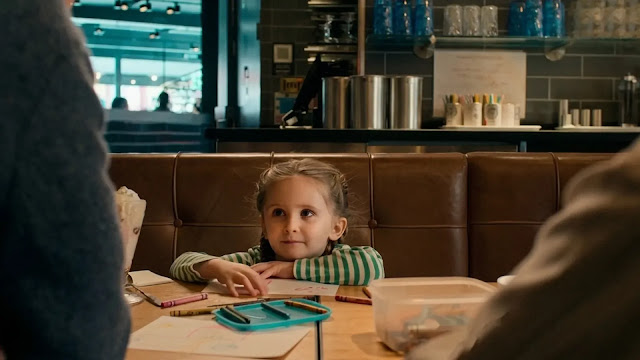
The movie ends on the egg. Not a hospital, not a monitor, not a speech. Tobias and their daughter stand at the counter and crack an egg the way Almut taught her, and then they get on with breakfast.