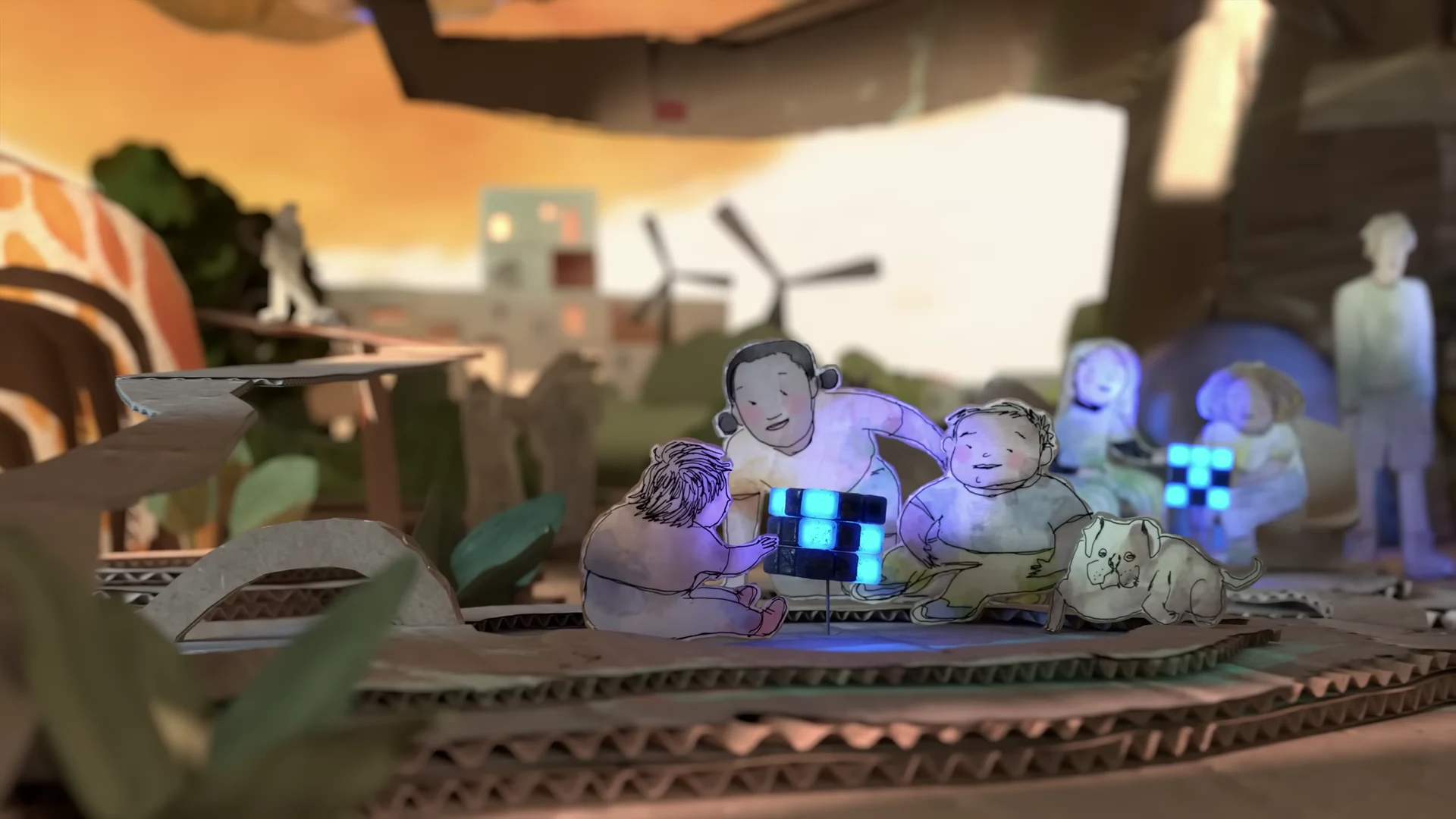
The AI Doc: Or How I Became an Apocaloptimist uses handmade animation because its directors wanted an intimate, tactile way into a subject usually explained through screens and expert interviews. Co-director Charlie Tyrell told POV that the imperfections of physical objects, including fingerprints on puppets, were part of the appeal. The choice gave the film a way to represent Daniel Roher’s anxiety as he prepared to become a father. A prediction about the future could become something he had to live with.
That makes the production worth looking at beyond the apparent irony of making an AI film by hand. How do you keep an audience with you through competing claims about a technology? And what happens when a painstakingly built image no longer fits the argument? Interviews with the filmmakers and editors offer useful answers to both. They also suggest a limit: knowing who made an image tells us about its construction, not whether the forecast beside it will come true.
The People Behind the Handmade Images
The animated sequences were produced by Stop Motion Department, which credits Philip Eddolls as animation director and cinematographer. Its production credits also name separate teams for art, animation, compositing and CG. That last pair is worth noticing. Handmade does not mean that a film has somehow escaped digital postproduction. Physical materials and computer-based work can belong to the same sequence, with different people responsible for different stages.
Those credits give a more useful answer to “Who made this?” than a broad claim about human creativity. Someone has to design an object, build it, light it, move it and integrate the resulting pictures. Calling the result handmade should direct attention toward those jobs. It should not make the work disappear into the personality of the director whose name is largest on the poster. Even a documentary built around one man’s questions needs many other people’s decisions.
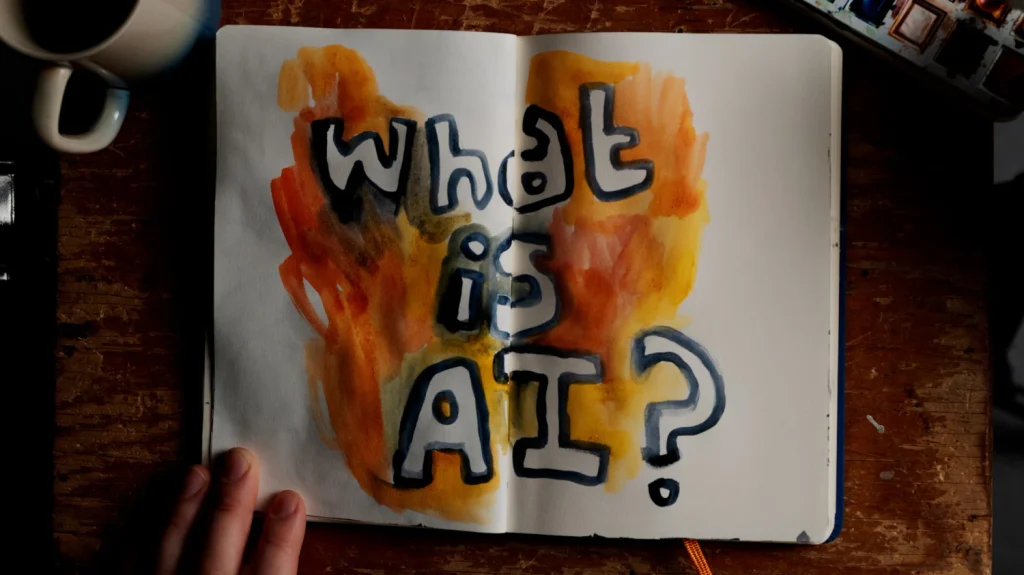
The official notebook still makes the approach concrete. The question “What is AI?” spreads across two pages in uneven lettering, surrounded by orange and yellow paint. A mug and a palette remain at the edges. There is no immaculate diagram promising to settle the subject. The image presents the question as a work in progress. Its usefulness comes from showing someone trying to understand, a modest position for a film surrounded by people making enormous predictions.
There is a useful comparison with the real boats and constructed interiors in The Ministry of Ungentlemanly Warfare. In that production, location work and sets served the same adventure. Here, physical objects and digital finishing can serve the same thought. Asking which materials were used opens up the filmmaking. Treating one material as a guarantee of honesty closes the question too soon.
An Expensive Image Still Has to Earn Its Place
The AI Doc’s animation changed as the documentary was edited. Editors Daysha Broadway and Davis Coombe explained to Art of the Cut that objects were built and photographed frame by frame, but some completed sequences lost their original purpose. A mountain animation was repurposed to express Roher’s anxiety. A separate section about the AI race moved toward news footage; Coombe described both the change in tone and pressure on the animation budget.
I like the mountain detail because it complicates the tidy story a publicity campaign might tell. The filmmakers did not settle on a visual language and then follow it without difficulty. They had an expensive piece of work on their hands and a changing film around it. Keeping the object required finding a new reason for its presence. That is an editorial decision as much as an animation decision, and the audience would have little reason to guess its history.
There is a danger in any labor-intensive film of letting the effort become its own justification. A beautiful sequence can be redundant. A clever metaphor can pull an explanation in the wrong direction. The editors’ account is valuable because it includes changes and constraints. It lets us ask whether the image clarifies the argument at this particular moment, instead of simply admiring how long somebody spent making it.
A Family Gives the Future a Timescale
Roher’s approaching fatherhood gave The AI Doc a personal reason to investigate the future. Tyrell told TheWrap that animation, notebooks and family material could help hold viewers through material that might otherwise become an extended run of interviews. The family perspective was shared behind the camera, too: Tyrell told POV that his child and Roher’s were born a week apart, a detail Broadway also discussed in the editing interview.
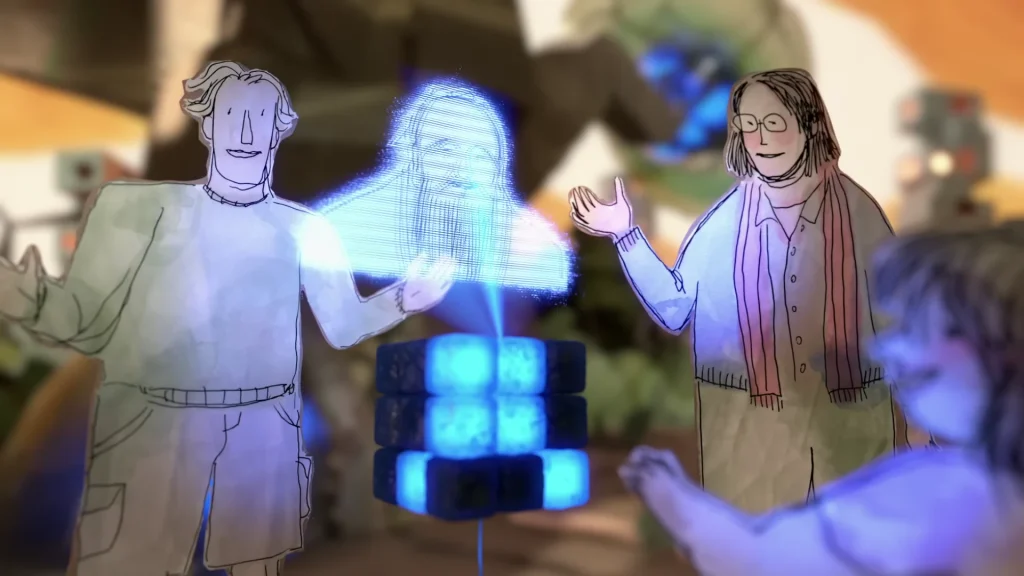
That gives an abstract future a duration we can grasp. A child will grow up while today’s promises are being tested. It also explains why this particular filmmaker keeps asking questions after the initial explanation of the technology is over. Understanding a mechanism would not finish his concern. He wants to know what kind of life will be possible around it. The official trailer places drawn people beside a glowing blue projection, bringing human figures into its technological imagery.
Producer Daniel Kwan told Focus Features that the team looked beyond rapidly changing capabilities to the economic, political and ideological forces driving development. That is a sensible way to give a documentary a longer useful life. A particular demonstration may date quickly. Questions about incentives can remain worth asking when the demonstrations improve.
Still, the filmmakers’ intention is not the same as a viewer’s conclusion. KQED critic Rae Alexandra described being left with uncertainty and a sense that ordinary people had little control over the future. Her response is a useful check on the idea that a personal, handmade approach automatically produces clarity or agency. An accessible account can still leave its central problem unresolved.
For this film, I would keep an eye on the transitions: when an interview gives way to a drawing or a model, what has become easier to understand? Sometimes an image explains an idea; sometimes it helps us recognize the person struggling with it. Both are worthwhile jobs. The distinction keeps the handmade work open to examination, which is a better way to appreciate it than granting it trust in advance.
1 thought on “The AI Doc: Why Its Animation Was Made by Hand”