The disappearing acts in Wonka’s The Golden Ticket were built to work in front of the contestants. According to illusion designer Adam Mada, the person sitting opposite a vanishing player had to be fooled along with the television audience. These were practical illusions, performed on set. Nobody was actually teleported, and the claim does not mean the finished series runs without editing. It means the surprise had to happen before the footage reached an editor.
That is a demanding way to stage a game show. Netflix’s competition brings a dozen pairs into Wonka’s factory, although the players compete as individuals. They arrive with someone familiar in a place designed to make familiar things unreliable. A sweet can carry a warning. A corridor can get smaller as you move through it. The useful question is how those surprises change the decisions people have to make while they are still trying to work out what happened.
The Person Across the Table Has to Believe It
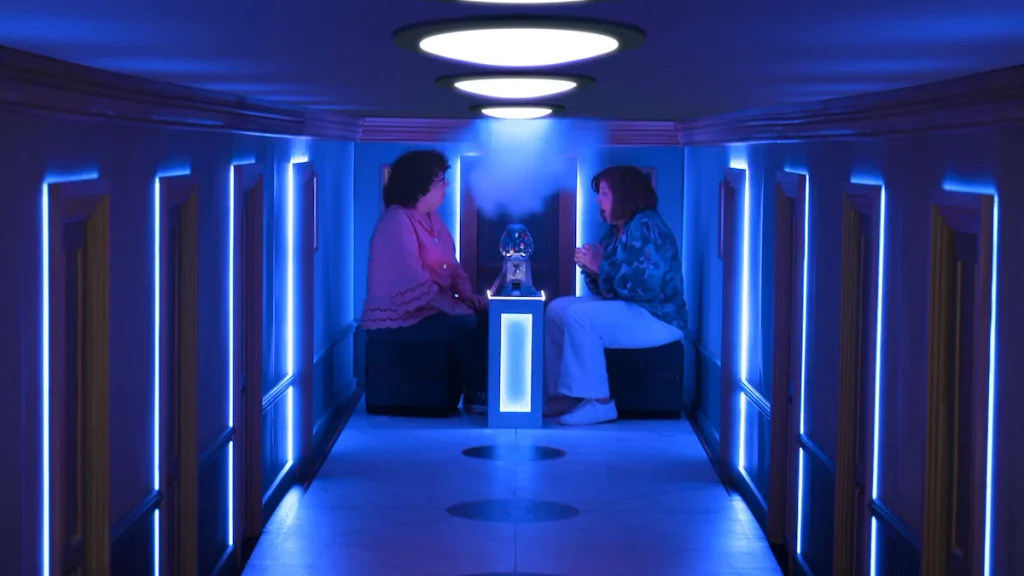
Mada described the disappearing challenge to TheWrap as a problem with several audiences: the player who vanishes, the companion watching, and the camera. The team built a replica set in Sydney to test the effect. Testing also required fresh people, because somebody who had already been through the trick could no longer supply an unsuspecting response. You can rehearse the machinery repeatedly; you cannot give a person their first surprise twice.
Mada’s published accounts describe what the gumball illusion had to accomplish without revealing its full mechanism. We can distinguish a live trick from an effect added afterward. We cannot reconstruct the apparatus from that description.
What interests me more than the size of the factory is the person left in the room. A companion gives the illusion someone to affect after the disappearance is over. The empty seat belongs to a person they came with. Even without knowing the hidden mechanism, we can understand the awkwardness of being left there, looking for an explanation from the same production that just arranged the deception. A magic act can finish with applause. Here, somebody still has to play.
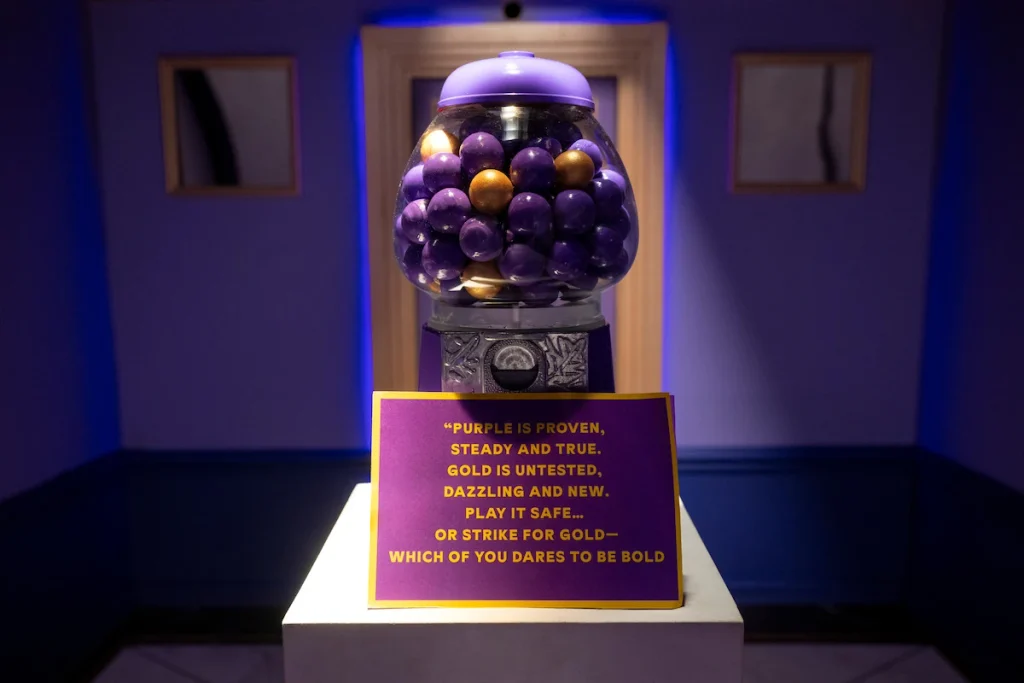
The official gumball photograph makes the choice unusually legible. Purple is presented as dependable, while gold is described as untested and dazzling. Those colors do some work before anyone touches the machine. Gold already suggests the ticket that got these people inside; purple asks them to accept something less exciting. I would watch how the invitation is worded as closely as the eventual trick. The show has started nudging a decision before revealing its consequences.
A Real Set Can Still Mislead You
The factory’s shrinking corridor is a physical construction, with a sloping ceiling and progressively smaller doors. Director Rich Kim told Netflix’s Tudum that cameras were concealed around the space. A Daily Beast reporter also experienced the corridor and a disappearance during a set visit. The room therefore had to accommodate people moving through it, people being deceived inside it, and a crew trying to preserve usable views of both.
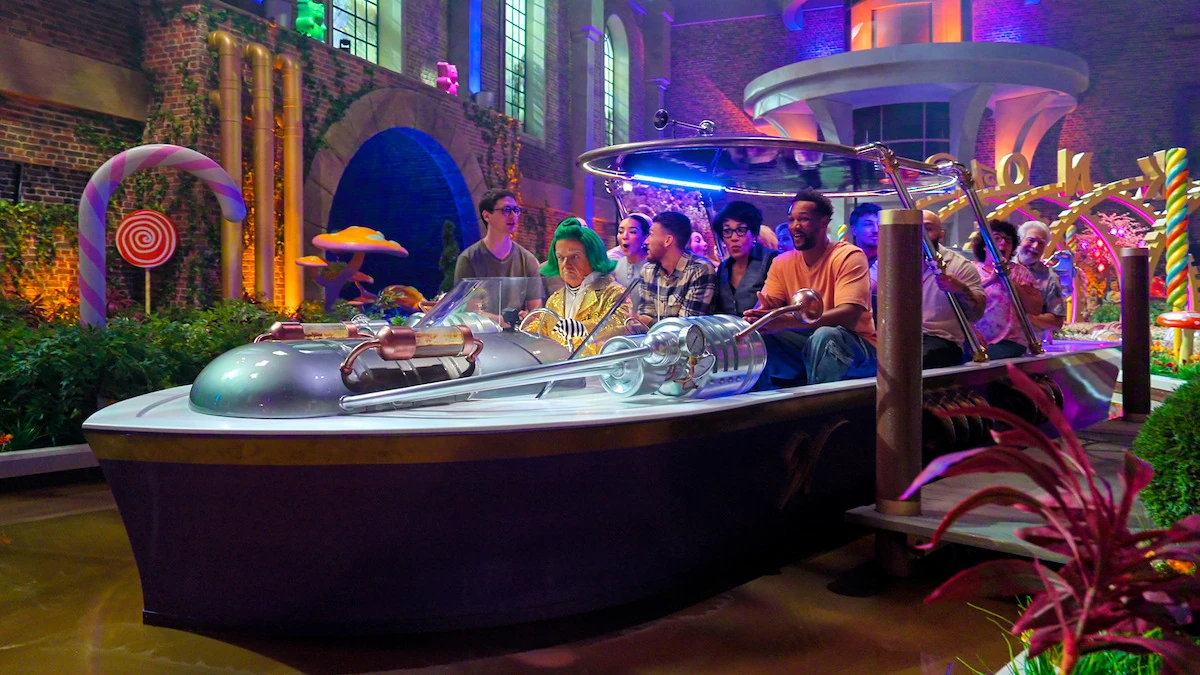
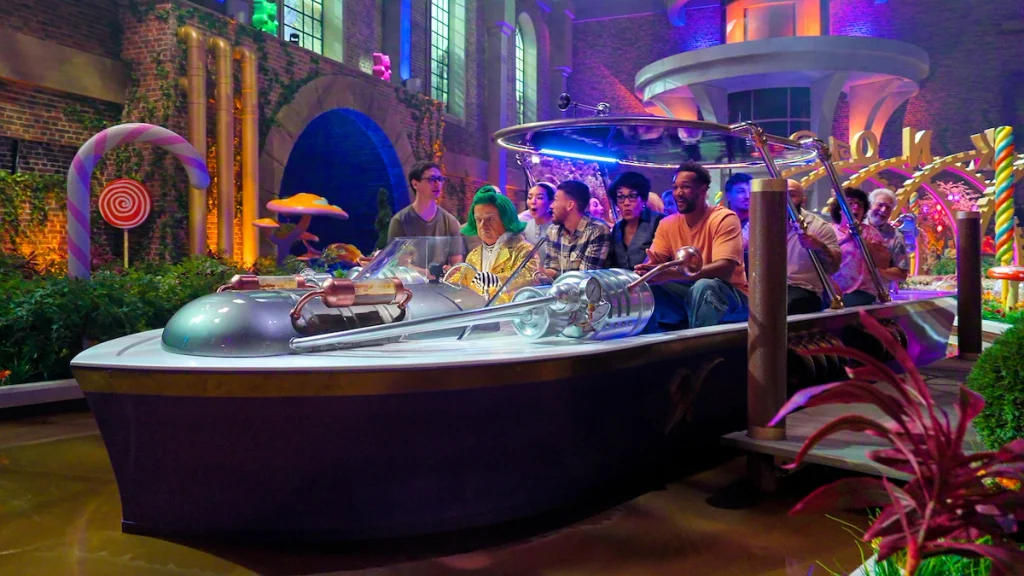
The chocolate river needs a different qualification. Netflix’s production FAQ describes a specially prepared, nonedible mixture. There was a river for the boat to travel through, but that does not make it a vat of drinking chocolate. The same FAQ says the elevator’s apparent journey was created with effects and lighting. These distinctions are part of the fun: the production built an environment that could persuade the people inside it while leaving them wrong about how it worked.
The handmade animation in The AI Doc offers a useful comparison. Its physical objects help present an argument or a person’s anxiety to viewers. Wonka’s props have another job: participants encounter them before the audience sees the edited result. A sign, a sweet, or a disappearing companion can become information they use in their next choice. The set is involved in producing the behavior the cameras are there to record.
Wonkavision Puts the Trick in Full View
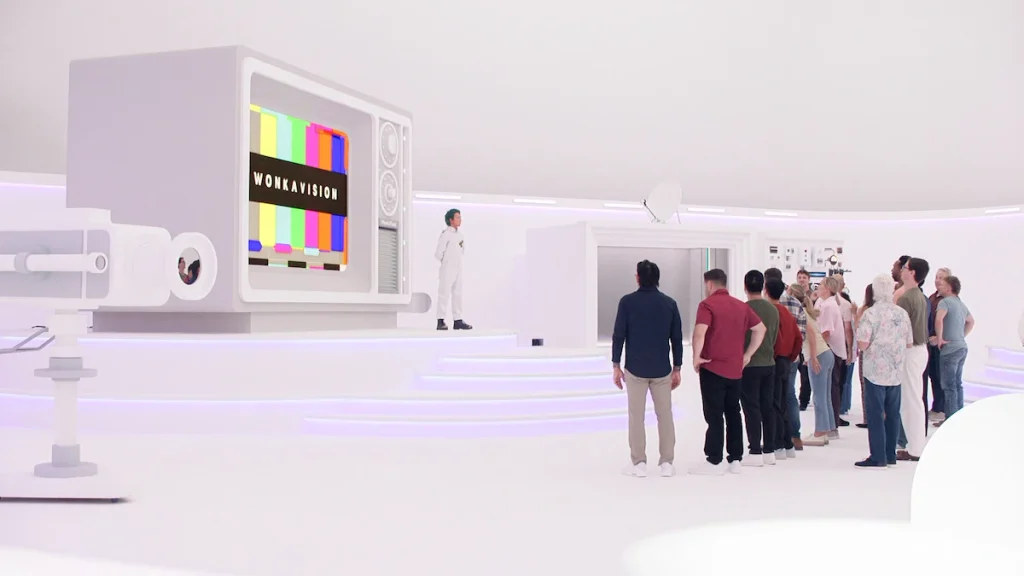
Wonkavision takes the same problem into a brightly lit studio, where Mada says hiding the illusion was especially difficult. His account describes people appearing to disappear in front of the other contestants. The official still shows how exposed the room looks: pale walls, open floor, a giant television, and players gathered where they can watch. The setting advertises visibility, which makes concealing the method an appealing design problem.
The Guardian’s Phil Harrison praised the set pieces but found the repeated disappearances slow and the competition familiar. His criticism raises a question the production accounts cannot settle: how much surprise survives repetition? An illusion can fool everybody in the room and still take too long to watch at home. The work needed to stage it deserves attention, but it cannot establish whether the resulting television is entertaining.
Nor does every element have a physical source. The show uses a re-created Gene Wilder voice with his estate’s approval. Its makers combine different techniques for different purposes; the live illusions are one part of that production, rather than a guarantee of authenticity for everything else.
My attention would go to the player left watching. Do they reconsider the next invitation, ask better questions, or choose gold again? The builders have explained why the first surprise was difficult to manufacture. I would be interested in the smaller moment afterward, when somebody has to decide whether to trust another offer from this very peculiar factory.