The premise of Remarkably Bright Creatures sounds like a pitch that got through on charm: an elderly widow bonds with a giant Pacific octopus and a wayward young man. On paper, the octopus is the hook. On screen, you forget about the octopus for long stretches, and that turns out to be both the film’s problem and its secret.
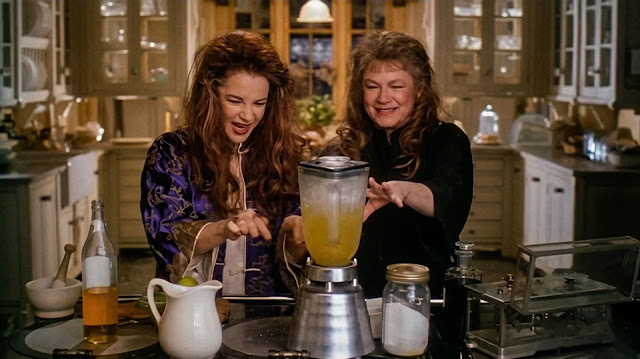
Netflix’s adaptation of Shelby Van Pelt’s 2022 novel — directed by Olivia Newman, streaming since May 8 — is, at its core, a film about two people with mirror-image losses finding each other in a small aquarium town. Tova Sullivan has outlived her husband and her son. Cameron Cassmore, a broke musician living out of a camper, is looking for the father he never knew. What they share, without knowing it at first, is a shaped absence at the center of their lives. The octopus watches. The film arranges its coincidences. And Sally Field does something that keeps you from caring too much about either.
<What Shelby Van Pelt’s Novel Becomes on Screen>
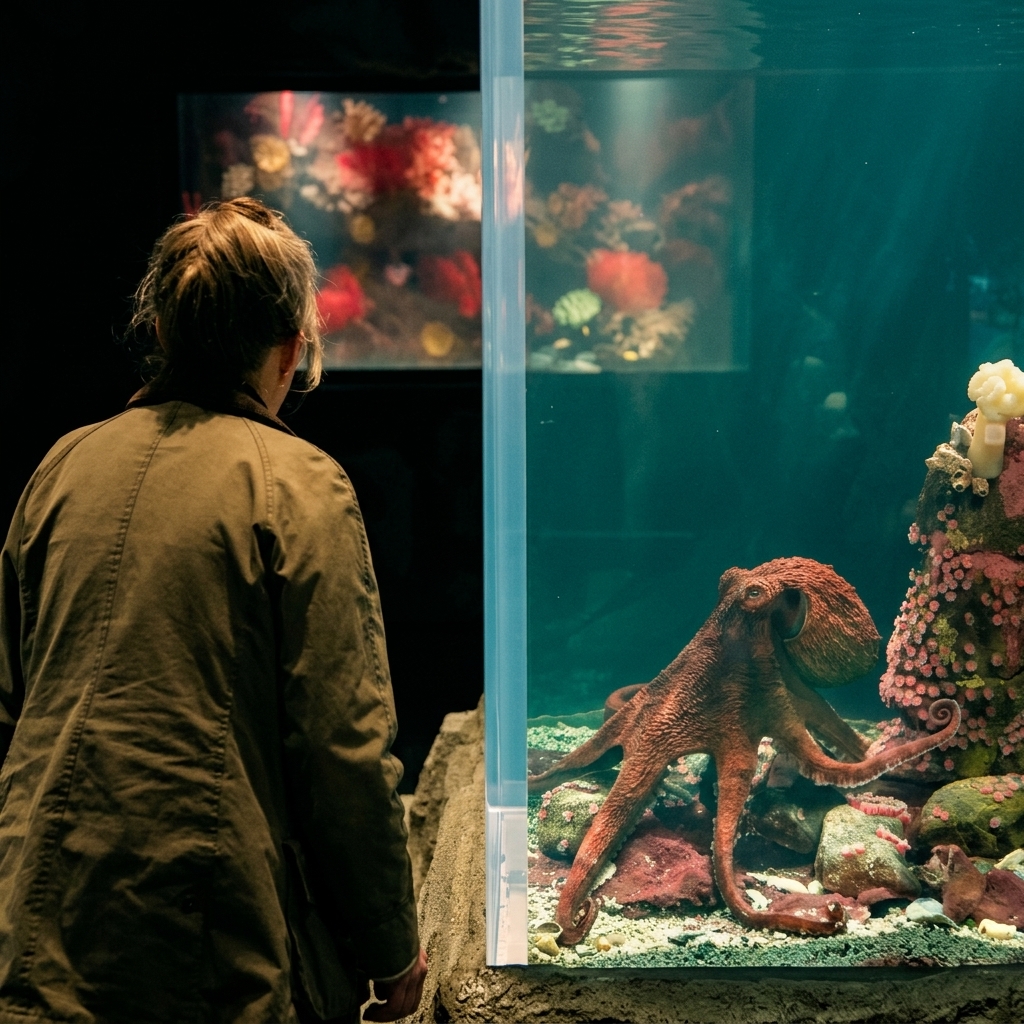
The novel’s structure alternates between Tova’s chapters and Marcellus’s — the octopus narrates from inside his tank, observing the humans who move through the aquarium with the detached curiosity of a creature that has watched several generations of keepers come and go. It’s a formally interesting choice on the page: Marcellus knows things the human characters don’t, and the dramatic irony accumulates slowly.
The film keeps the narration — Alfred Molina provides Marcellus’s voice with exactly the right weight of ironic wisdom — but the adaptation loses much of what made it work. In the novel, Marcellus is an active consciousness with genuine stakes. On screen, he is closer to ambient presence, commenting on scenes he witnesses but rarely driving them. The revelation that brings Tova and Cameron together — that Cameron is the son of Tova’s deceased son Erik, making them grandmother and grandson — arrives through plot mechanics that feel engineered rather than discovered. A ring returns. A DNA test confirms. The octopus is nearby.
This is the version of the story where the human drama works and the magical realist premise never quite earns its keep. Audiences who loved the novel for Marcellus specifically may find that gap frustrating. The film is betting that they’ll love it for Sally Field instead.
<What Sally Field Does With Grief>
That bet pays. Field’s Tova is a woman who has organized her survival around not asking for anything — from her neighbors, from her memories, from herself. She cleans the aquarium at night because the routine holds. She attends her knitting club because the social obligation holds. She keeps her grief at a distance that is starting to look, from the outside, like peace, and Field plays the distinction between those two things with a precision that the screenplay alone doesn’t quite reach.
The third act contains a scene in which Tova speaks about her son that is as good as anything Field has done in a career that includes Norma Rae and Places in the Heart. It’s a monologue that stops the film. Not because it’s showy — it isn’t — but because Field has spent the previous ninety minutes laying the groundwork so carefully that when it arrives, you understand exactly what it cost her character to say the words out loud. Critics on set reported that her fellow castmates visibly reacted in the moment. Watching the finished film, you understand why.
She has been doing this for fifty years: finding the human truth in material that doesn’t always deserve it, and making the material look like it did all along.
<Lewis Pullman and the Chemistry That Makes It Work>
Cameron is the harder role to play, because he’s the one the film asks us to meet with less context. He shows up in town because his car breaks down, takes a job at the aquarium, and gravitates toward Tova through a combination of plot necessity and something that reads, on screen, as genuine. Lewis Pullman handles the role with a loose, undefended quality that makes Cameron’s searching feel real rather than convenient — he is actually looking for something, and Pullman doesn’t tidy that into charm.
What holds the film together is what happens when Field and Pullman share the screen. Their scenes have a specific texture: two people who are politely circling each other, aware that the other has something to offer, unwilling to admit they need it. The chemistry doesn’t read as romantic despite the thirty-year age gap and the film’s occasional gesture toward something warmer — it reads as recognitional. Each of them sees in the other the thing they’ve been missing. The fact that they are, biologically, family is almost secondary to that dynamic, which is why the film’s resolution works even though you can see it coming from the first act.
<A Sweet Film Carrying More Weight Than It Shows>
Remarkably Bright Creatures has an 83% on Rotten Tomatoes and a 55 on Metacritic, and that gap tells you something accurate about what kind of film it is. Critics who are charmed by it are charmed genuinely. Critics who find it too tidy are also right. Both groups are describing the same movie.
It is, without question, a film that relies on coincidence. The plot contrivances that bring Tova and Cameron together — the ankle injury, the car trouble, the ring that Marcellus returns at the right moment — are visible as mechanisms. The supporting characters, a knitting club that includes Joan Chen and Kathy Baker, function mostly as warmth delivery systems. Colm Meaney does quiet, dignified work as a man with feelings for Tova that he doesn’t know how to express. None of this is subtle.
What is subtle is what Field is doing underneath it. And Alfred Molina, who voices Marcellus here having recently appeared onscreen in The Boroughs, brings enough gravity to the octopus’s observations that you occasionally wish the film trusted him more. There is a version of Remarkably Bright Creatures that is stranger and more formally ambitious, one that commits to what it means for a creature with nine brains and the capacity to open any lock to watch human grief from behind glass. This film doesn’t make that version. It makes a warmer, more manageable one.
That version is still worth watching. Grief films live or die on whether they earn their emotional conclusions, and this one earns them — not through the writing, but through two actors who understand that the gap between what people carry and what they show is where all the real information lives.
Tova learns that grief doesn’t mean you stop deserving things. Cameron learns that family is a form of recognition before it’s a biological fact. Marcellus watches all of it and keeps whatever he knows to himself, which is, finally, the most interesting thing about him.